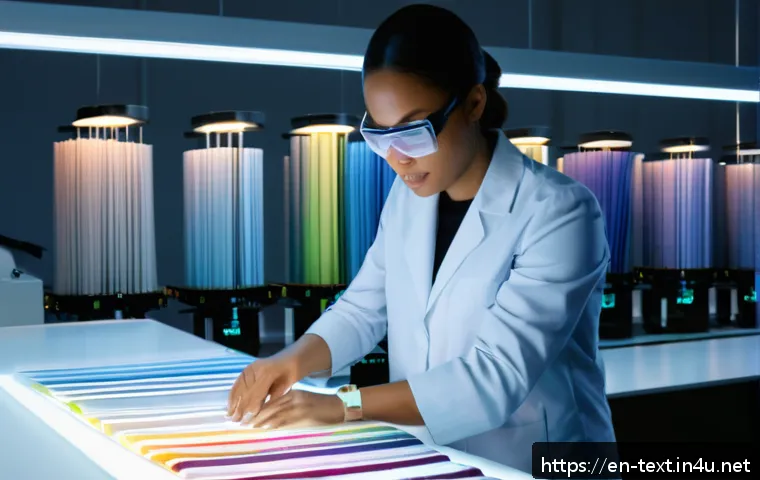
I remember the late nights, meticulously optimizing fabric blends and production lines, feeling like my entire world revolved around threads and looms.
For years, being a textile engineer was more than a job; it was my identity. But then, it felt like the very ground beneath my feet started to shift. The whispers of ‘sustainability’ grew into roars, digital transformation became non-negotiable, and suddenly, the traditional paths seemed less clear, more fraught with uncertainty.
I personally found myself questioning if my specialized expertise would still be relevant in an era dominated by smart fabrics, circular economy principles, and AI-driven manufacturing.
It’s a strange feeling, that mix of apprehension and exhilaration when you realize your deep technical knowledge, far from being a limitation, could actually be your greatest asset in navigating this evolving landscape.
We’re seeing a massive pivot, from linear production to truly innovative, cross-sector applications where materials science is king. If you’ve been feeling that same itch, that nagging thought about what’s next for your textile engineering career, know you’re far from alone.
The good news? Your unique skillset is surprisingly adaptable, opening doors you might not even have considered. We’ll get into the exact specifics.
Navigating the Evolving Landscape of Material Science: Beyond Traditional Looms

The textile industry, as many of us have known it for decades, is in a profound state of flux. I remember vividly the days when innovation often meant tweaking a new blend for better durability or a more vibrant dye.
Now, it feels like the very definition of a “textile” is expanding, blurring lines with electronics, medicine, and advanced computing. This isn’t just about fashion or home goods anymore; we’re talking about smart bandages that monitor vital signs, self-cleaning fabrics, and materials that generate energy.
When I first started seeing these shifts, I’ll admit, a part of me felt a cold dread. Would my deep understanding of warp and weft, of polymer structures and dyeing processes, become obsolete?
But then, something clicked. My foundational knowledge, honed over years of problem-solving on the factory floor and in the lab, wasn’t a relic; it was the bedrock for understanding these complex new frontiers.
It’s about recognizing that the core principles of material science, thermodynamics, fluid dynamics, and mechanical engineering that we textile engineers master are fundamentally transferable, providing an incredibly unique perspective on the materials of tomorrow.
1. The Shifting Sands of Industry Demand and Opportunity
The global push for sustainability, coupled with rapid advancements in digital manufacturing, has fundamentally reshaped what businesses are looking for.
Traditional roles are evolving, and entirely new ones are emerging. For instance, brands are now prioritizing circularity—designing products that can be easily recycled or biodegraded, a concept that requires a deep understanding of material composition and end-of-life possibilities, areas where textile engineers inherently excel.
I’ve personally seen former colleagues, once focused on mass production, now leading initiatives in fiber recycling or developing bio-based alternatives.
There’s a palpable shift from mere efficiency to holistic impact, and this requires a kind of interdisciplinary thinking that engineers, with their systematic problem-solving approach, are perfectly poised to deliver.
This isn’t just a trend; it’s a fundamental recalibration of what constitutes value in our industry.
2. Identifying Your Unique Edge in a Crowded Market
In a world increasingly driven by data and digital solutions, it might seem like a software engineer holds all the cards. But consider this: who truly understands the physical properties of a material when it needs to bend, stretch, conduct, or insulate?
Who can troubleshoot a production line when a composite material isn’t behaving as expected? That’s us. Our hands-on experience with material behavior, our intuitive grasp of how processes impact performance, and our ability to bridge the gap between theoretical science and tangible product is our superpower.
I remember countless hours spent troubleshooting a particularly stubborn fabric defect, relying not just on formulas, but on an almost innate feel for the material.
This kind of nuanced, experiential knowledge is incredibly difficult to replicate with AI alone, making our skillset irreplaceable in the development and scaling of next-generation materials and products.
Unlocking Hidden Value: How Your Core Skills Translate
It’s easy to get caught up in the idea that a career change means starting from scratch. But for textile engineers, it’s rarely about abandoning your expertise; it’s about recognizing how your existing skills can be reapplied, recontextualized, and even amplified in new domains.
Think of it like a master craftsman learning to use their tools for a new art form. The dexterity, precision, and foundational understanding remain, only the canvas changes.
I’ve always believed that the problem-solving mindset inherent in engineering is perhaps our most valuable, portable asset. Every challenge in product development, supply chain optimization, or quality control, regardless of the industry, benefits from that structured, analytical approach we cultivate.
1. Material Science as the New Language of Innovation
At its heart, textile engineering is a specialized branch of material science. Whether we’re optimizing the strength-to-weight ratio of a carbon fiber composite or developing a breathable membrane for athletic wear, we’re fundamentally working with the structure and properties of materials.
This deep understanding is not confined to fabrics. It’s highly sought after in aerospace for lightweight components, in biomedical for biocompatible implants, in automotive for interior solutions, and in construction for advanced insulation.
I’ve witnessed former colleagues transition into roles at companies developing everything from advanced packaging materials to cutting-edge medical devices, all because their core understanding of polymer chemistry, fiber structure, and material testing was directly applicable.
It’s about recognizing that the “textile” part of our title is often just one application of a much broader, highly valuable skillset.
2. Process Optimization: A Skill Beyond Fabric Production
My days used to be filled with optimizing weaving patterns, managing dye baths, and streamlining production lines for maximum output and minimal waste.
This wasn’t just about textiles; it was about efficiency, quality control, and resource management. These are universal challenges in virtually every manufacturing industry.
The ability to identify bottlenecks, implement lean methodologies, and ensure consistent quality, which we do instinctively in textile production, is a goldmine for companies outside our traditional domain.
From consumer electronics assembly to pharmaceutical manufacturing, businesses are desperate for individuals who can look at a complex process, dissect it, and find ways to make it better, faster, and more cost-effective.
I’ve seen textile engineers lead transformations in unrelated industries purely based on their process acumen.
3. Quality Assurance Reimagined: From Threads to Tech
If there’s one thing a textile engineer knows, it’s quality. We live and breathe tensile strength, colorfastness, abrasion resistance, and dimensional stability.
We understand the critical importance of rigorous testing, statistical process control, and root cause analysis when defects occur. This meticulous approach to quality assurance is incredibly transferable.
Imagine the level of detail required for a medical device or an aerospace component – it dwarfs even the most demanding textile specifications. Our training in identifying flaws, understanding failure modes, and implementing corrective actions makes us invaluable in any industry where product reliability is paramount.
I personally feel a deep sense of pride when I see textile engineering principles of robust quality management being applied to fields as diverse as microchip manufacturing or food processing.
The Rise of Smart Textiles and Wearables: A New Frontier
This is where things get truly exciting, and where my own personal journey has seen some of the most profound shifts. The convergence of traditional textile craftsmanship with cutting-edge electronics and data science is creating entirely new product categories that are revolution both daily life and specialized industries.
What was once the stuff of science fiction — clothing that monitors your heart rate, uniforms that regulate temperature, or bandages that deliver medication — is now becoming a commercial reality, and textile engineers are at the very heart of this revolution.
1. Integrating Technology with Fabric: The Future is Now
This isn’t just about gluing a sensor onto a shirt. It’s about embedding conductive yarns, integrating micro-sensors directly into the fabric structure, and developing flexible circuits that can withstand washing, stretching, and daily wear.
It requires a nuanced understanding of how different materials interact – the textile’s mechanical properties, the electronic component’s conductivity, and the interface between the two.
When I first started grappling with the idea of ‘e-textiles,’ it felt like learning a new language entirely. But I quickly realized that my foundational knowledge of fiber properties, weaving techniques, and finishing processes gave me a unique advantage in understanding how to make these complex systems robust and wearable.
It’s a field that demands both the tactile understanding of fabric and the analytical precision of electronics, a perfect storm for a textile engineer.
2. From Medical Devices to Performance Gear: Diverse Applications
The applications for smart textiles are incredibly broad and continually expanding. In healthcare, we’re seeing smart garments that monitor chronic conditions, track rehabilitation progress, or even provide haptic feedback for therapy.
For athletes, performance wear can measure everything from muscle activity to hydration levels, optimizing training and preventing injuries. Beyond that, consider defense applications like camouflage that adapts to surroundings, or industrial safety gear that detects hazardous chemicals.
Each of these requires a textile engineer who can bridge the gap between the functional demands of the product and the material science needed to make it work.
It’s a testament to the versatility of our foundational knowledge.
| Traditional Textile Engineering Focus | Emerging/Transferred Roles & Skills |
|---|---|
| Fabric Weaving & Knitting Processes | Advanced Composite Manufacturing, 3D Printing (Additive Manufacturing), Biomedical Scaffold Design |
| Dyeing & Finishing Chemistry | Sustainable Material Development, Bio-based Polymer Research, Functional Coatings for Electronics |
| Quality Control & Testing (Physical Properties) | Product Reliability Engineering, Advanced Material Characterization, Wearable Sensor Integration & Validation |
| Supply Chain & Production Management | Circular Economy Consulting, Sustainable Sourcing Strategy, Digital Supply Chain Optimization |
| Fiber Science & Yarn Technology | Nanomaterial Development, Smart Textile Component Design, Filtration Media Engineering |
Embracing Circularity: Opportunities in Sustainable Production
The global consciousness around environmental impact has dramatically shifted, and with it, the demands placed on industries like textiles. For a long time, the linear “take-make-dispose” model dominated, but now, the imperative is to move towards a circular economy.
This isn’t just about being “green”; it’s about fundamental systemic change that offers immense opportunities for those with the right expertise. I’ve found this area particularly resonant, as it aligns with a growing personal desire to contribute meaningfully to a more sustainable future.
My years of understanding material lifecycles, even if previously focused on optimizing for first use, now provide an invaluable lens for designing for reuse and recycling.
1. Designing for Disassembly: The Cradle-to-Cradle Philosophy
One of the core tenets of the circular economy is “designing for disassembly,” or more broadly, the “cradle-to-cradle” approach. This means thinking about a product’s entire lifecycle from its inception: how will its components be recovered?
Can the materials be safely recycled back into new products? This is a huge shift from simply making a product durable. It requires an intimate knowledge of material compatibility, bonding agents, and the feasibility of separating different components post-consumer use.
As textile engineers, we understand the complexities of multi-fiber blends, the challenges of dyeing and finishing processes that can hinder recycling, and the properties of natural versus synthetic fibers.
This makes us uniquely qualified to advise on material selection and design strategies that enable true circularity, transforming waste into resources.
It’s an area where our expertise can genuinely drive impact.
2. Supply Chain Transparency and Ethical Sourcing
Beyond the materials themselves, the entire supply chain is under scrutiny. Consumers, regulators, and investors are increasingly demanding transparency and ethical practices.
This means knowing where your raw materials come from, how they’re processed, and ensuring fair labor practices throughout the production line. For textile engineers, this opens up roles in supply chain auditing, sustainability consulting, and developing traceability systems.
My experience tracking raw material batches, understanding manufacturing origins, and ensuring compliance with various standards has given me a practical foundation for these complex challenges.
It’s about more than just technical specifications; it’s about building trust and ensuring that the fabric of our products is woven with integrity.
From Lab to Market: The Entrepreneurial Path
Perhaps one of the most exciting, albeit challenging, avenues for a textile engineer in this new era is entrepreneurship. With the rapid pace of innovation and the emergence of entirely new material categories, there’s a fertile ground for those willing to take the leap and build something from the ground up.
I’ve personally been inspired by the tenacity of former classmates who, instead of seeking traditional employment, decided to spin off their own ventures focusing on everything from smart fabric sensors to sustainable dyes.
It’s a terrifying but exhilarating prospect, demanding not just technical prowess but also a keen business sense and a willingness to learn on the fly.
1. Spotting Market Gaps: Your Niche Awaits
Our deep, specialized knowledge often allows us to see problems and opportunities that generalists miss. Perhaps you’ve noticed a persistent performance issue with a certain type of industrial fabric, or a need for a more sustainable alternative in a niche market.
Your years of hands-on experience give you an unparalleled insight into the “unmet needs” within material science and product development. This could be a new method for recycling mixed fibers, a novel coating for medical textiles, or even a specialized material for space exploration.
The key is to combine your technical expertise with market research to identify where your unique solution can truly make an impact and capture value.
2. Building a Prototype: From Concept to Tangible Product
This is where the engineering really comes alive. Having identified a market gap, the next step is to translate your concept into a tangible prototype.
For textile engineers, this often means working with advanced manufacturing techniques like 3D printing, electrospinning, or sophisticated weaving machinery to create a proof-of-concept.
It’s about iterative design, testing, and refining, drawing upon your understanding of material properties and manufacturing processes. There’s an immense satisfaction in seeing your theoretical ideas manifest into a physical product, something I’ve always cherished since my first days in the textile lab.
This is where your hands-on problem-solving skills shine brightest.
3. Funding Your Vision: Grants, Angels, and Venture Capital
Once you have a viable prototype and a clear market proposition, the next hurdle is securing funding. This can involve applying for government grants for innovative technologies, pitching to angel investors who specialize in material science or sustainable tech, or seeking venture capital from firms looking for disruptive innovations.
It requires articulating not just the technical feasibility of your solution, but also its market potential and scalability. It’s a learning curve for sure, but your technical credibility as an engineer often provides a strong foundation for convincing investors of your vision.
Lifelong Learning: Adapting Your Expertise for Tomorrow
The landscape of material science is not static; it’s a dynamic, ever-evolving field. To remain relevant and continue growing, a commitment to lifelong learning is non-negotiable.
This isn’t just about formal education; it’s about curiosity, networking, and a proactive approach to skill development. I’ve personally found that the moment you think you know it all is precisely when you start falling behind.
The truly valuable textile engineers I’ve encountered are those who embrace continuous learning as an integral part of their professional identity.
1. Specialized Certifications and Micro-credentials
To bridge any skill gaps and signal your expanded capabilities to potential employers or collaborators, specialized certifications can be incredibly valuable.
Consider certifications in areas like sustainable materials management, lean manufacturing, data analytics for manufacturing, or even specific software relevant to advanced material design.
Many universities and industry organizations offer “micro-credentials” or short courses that allow you to quickly gain expertise in emerging areas without committing to a full degree.
This focused learning allows you to layer new, in-demand skills on top of your robust engineering foundation.
2. Networking Beyond Your Niche: Interdisciplinary Collaboration
One of the biggest eye-openers for me was realizing the power of networking outside my immediate textile circle. Attending conferences on nanotechnology, biomedical engineering, or even artificial intelligence has opened doors to unexpected collaborations and broadened my perspective immensely.
These interactions reveal how textile engineering principles can be applied in seemingly unrelated fields. Engaging with professionals from diverse backgrounds not only provides new learning opportunities but also helps identify emerging trends and potential career paths you might never have considered.
It’s about building a wider web of knowledge and connections.
Crafting Your Narrative: Communicating Your Evolving Value
Finally, it’s not enough to simply *have* transferable skills; you need to be able to articulate them effectively. This is where many engineers, myself included, sometimes stumble.
We’re great at designing and analyzing, but not always at storytelling. In a world where your career path might not be linear, your ability to communicate your journey, your expertise, and your potential contributions in a compelling way becomes paramount.
1. Crafting a Modern Resume and Portfolio
Your resume shouldn’t just list job duties; it needs to tell a story of growth and adaptability. Instead of simply stating “Managed production line,” consider phrasing like “Optimized complex manufacturing processes, resulting in a 15% reduction in waste, demonstrating transferable skills in lean methodology and resource efficiency.” Highlight projects where you’ve applied textile engineering principles to solve broader material science challenges.
If you’ve worked on any innovative materials, e-textiles, or sustainability initiatives, create a portfolio (digital or physical) that showcases your contributions and the tangible results.
This shift in focus from mere tasks to impactful outcomes is crucial.
2. Mastering the Interview: Articulating Your Evolving Role
Interviews become less about reciting technical specifications and more about demonstrating your problem-solving mindset and adaptability. Be prepared to share specific examples of how you’ve used your textile engineering background to tackle novel challenges.
When asked about your experience, don’t just talk about textiles; pivot to the underlying engineering principles. For instance, if you optimized a dyeing process, explain how that experience makes you proficient in chemical process control, relevant to diverse industries.
It’s about framing your specialized expertise not as a limitation, but as a unique advantage that allows you to bring a fresh, experienced perspective to new problems.
Concluding Thoughts
So, as we stand at the precipice of this thrilling new era, it’s clear that the path for textile engineers is anything but narrow. What might have once felt like a niche discipline has truly evolved into a foundational skill set for a multitude of cutting-edge industries.
My own journey, filled with unexpected turns and constant learning, has reinforced my belief that our expertise isn’t just relevant; it’s vital. Embrace the challenge, keep that engineer’s problem-solving spirit alive, and remember that the threads of your career can weave into an incredibly diverse and impactful tapestry.
Useful Resources
1.
Explore Interdisciplinary Online Courses: Platforms like Coursera, edX, or even university extensions offer specialized courses in advanced materials, biomedical engineering, data analytics for manufacturing, or sustainable supply chain management. These can quickly bridge knowledge gaps.
2.
Join Professional Organizations Beyond Textiles: While textile associations are crucial, consider joining groups like the Material Research Society (MRS), AIChE (American Institute of Chemical Engineers), or associations focused on sustainability or specific advanced industries (e.g., aerospace, medical devices). This expands your network and insights.
3.
Leverage LinkedIn for Industry Insights: Follow thought leaders, companies, and emerging technology groups in fields like smart textiles, additive manufacturing, or circular economy. Engage with content, ask questions, and identify potential mentors or collaborators.
4.
Attend Cross-Industry Conferences and Workshops: Look for events that merge material science with other disciplines. These are excellent places to discover new applications for your skills and meet professionals from diverse backgrounds.
5.
Seek Out Mentorship: Connect with experienced professionals who have successfully transitioned into new roles or industries. Their insights can be invaluable for navigating career changes and identifying growth opportunities.
Key Takeaways
Our foundational knowledge in textile engineering provides a robust bedrock for navigating the evolving landscape of material science. The demand for our expertise in material science, process optimization, and quality assurance is expanding far beyond traditional textiles into diverse, high-growth sectors.
Embrace continuous learning and interdisciplinary collaboration to unlock new opportunities in smart textiles, sustainability, and entrepreneurship. Effectively communicate your transferable skills to articulate your unique value in an ever-changing professional world.
Frequently Asked Questions (FAQ) 📖
Q: I’ve spent years meticulously optimizing traditional textile processes and blends. How can my deeply specialized expertise truly remain relevant when the industry seems obsessed with smart fabrics,
A: I, and circular economy principles? A1: I completely understand that feeling, truly. I was right there, staring at my warp beams, wondering if my entire career was about to be outsourced to an algorithm.
But here’s the powerful truth: your foundational knowledge – the one you built thread by thread, year after year – is not obsolete; it’s actually your superpower in this new landscape.
Think about it: AI can analyze data, but it doesn’t understand the nuanced interaction of fibers under stress, the tactile feel of a specific weave, or the subtle ways a dye reacts to different finishes.
You do. Your expertise in material behavior, manufacturing processes, and quality control is what will inform the design of those smart fabrics, the implementation of AI-driven production lines, and the feasibility of circular models.
I personally found a massive shift in my own perspective when I realized my understanding of fabric construction was indispensable for designing conductive textiles – it wasn’t about abandoning my past, but about building an incredible future on that solid foundation.
Q: If I’m ready to pivot, what are some tangible, real-world avenues for textile engineers that aren’t just the same old factory floor? Where can my unique skillset truly shine?
A: This is where it gets genuinely exciting! We’re talking about a world far beyond just apparel or home goods now. Your deep dive into materials makes you an invaluable asset in sectors you might not have even considered.
Think medical textiles: developing advanced wound dressings, biocompatible implants, or even smart surgical garments that monitor vital signs. Or consider wearable technology, where your material science knowledge is critical for creating comfortable, functional devices – making sure the sensors are seamlessly integrated and the fabric itself contributes to performance.
I recently consulted for an aerospace company, believe it or not, on lightweight, high-performance materials for cabin interiors. My background in advanced composites and material testing was exactly what they needed.
Then there’s sustainable innovation consulting for brands trying to navigate the circular economy, or even automotive and industrial textiles requiring specific durability, fire retardancy, or insulation properties.
Your skillset is remarkably adaptable; it’s about applying your core understanding to new, pressing challenges.
Q: This all sounds promising, but frankly, it also feels a bit overwhelming. How do I even begin to navigate this shift without feeling completely lost or having to go back to square one?
A: Oh, that feeling of “where do I even begin?” is totally normal, believe me. I felt it too, that mix of apprehension and exhilaration. You absolutely do not have to go back to square one.
Think of it more as expanding your existing expertise, not erasing it. Start small. Perhaps identify one area that truly sparks your interest – maybe sustainable dyeing, or sensors in fabric – and then dive into targeted learning.
There are excellent online courses from reputable universities, industry certifications, or even specific workshops that can bridge gaps without demanding a full degree.
I found that connecting with people in these emerging fields – through LinkedIn, industry events, or even just informational interviews – was incredibly illuminating.
Hearing their challenges often revealed how my existing knowledge could be directly applied. It’s less about a grand, sudden pivot and more about building new pathways brick by brick, leveraging the incredible foundation you already have.
You’re not starting from scratch; you’re just finding new, exciting applications for your hard-earned wisdom.
📚 References
Wikipedia Encyclopedia
구글 검색 결과
구글 검색 결과
구글 검색 결과
구글 검색 결과
구글 검색 결과